Web Application Development
Web applications that make the work clearer.
Teqaniyah develops web applications for customer services, internal operations and digital products. We plan the roles, records and decisions behind each screen, so the interface and backend support the same workflow.
Based in Amman, Jordan · Arabic & English
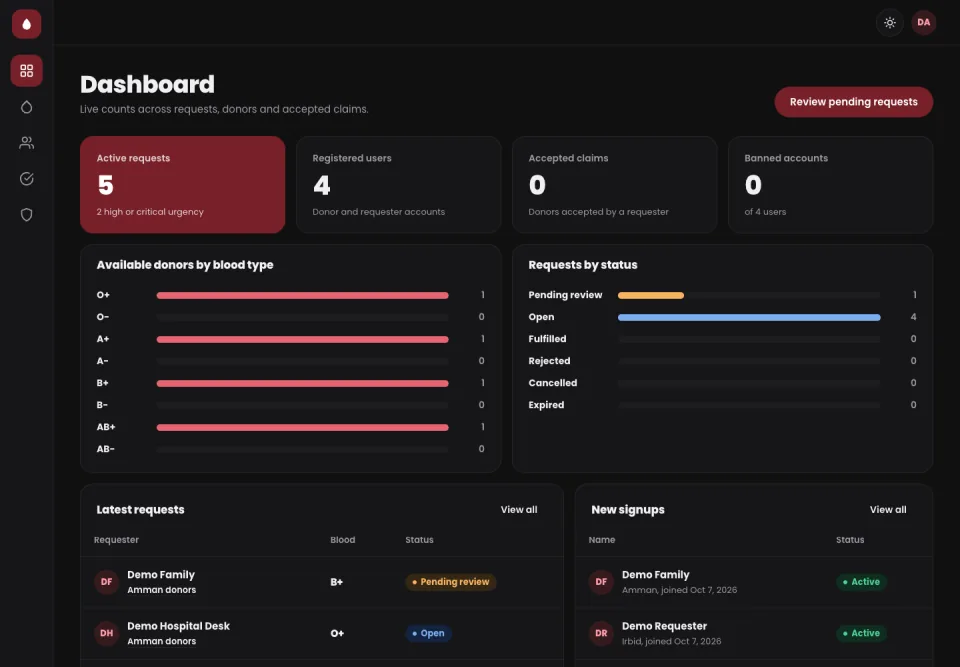
Fictional data. Explore the case study for the implementation and verification boundaries.
When it fits
When your product needs accounts, changing data or coordinated actions, a website alone may not be enough.
Customer and partner portals
Give people a place to manage their information, submit requests or follow progress. Define what each role can see and change before designing the screens.
Internal tools and administration
Bring review queues, catalog management and operational records into a shared workspace. Start with the actual decisions your team makes, rather than a dashboard full of unused charts.
A backend for a digital product
Connect a mobile app or browser interface to APIs and persistent data. Agree the boundaries between users, staff and administrative operations.
What we can build
Scope the workflow and the infrastructure together. A polished interface should not hide fragile business logic.
Responsive interfaces
Design forms, tables and navigation for the devices people use. Account for keyboard access, readable content, validation and Arabic/English layouts.
Roles and business workflows
Define authentication, permissions and record states. Enforce important rules on the backend instead of depending on disabled buttons or hidden menu items.
APIs and persistent data
Build or integrate services and a database around the agreed records and actions. Technology choices can include Next.js or Laravel, based on the problem and existing systems.
Deployment and operational handover
Plan environment configuration, deployment, backups and recovery checks appropriate to the scope. Agree source access, documentation and who maintains the service after launch.
The final deliverables, schedule, ownership and support responsibilities are agreed in the project scope—not assumed from this page.
How we approach it
Map roles and records
Understand the users, current workflow, data sources and decisions. Identify the permissions and integrations the first version needs.
Review the working interface
Design the main forms, tables and state changes. Include empty and error states, mobile layouts and language requirements.
Build the rules and screens
Implement reviewable slices across the interface, API and data layer. Verify permissions and validation, not just the happy path.
Prepare to operate it
Check agreed workflows and deployment configuration. Document environments, responsibilities and recovery needs before handover.
Relevant work
These are projects from founder Mohammad Shams’s own portfolio, not client endorsements. Screenshots use fictional local demo data; they are not usage or outcome metrics.
Next.js · Staff operations
Hayah
A staff console and API for reviewing blood requests, managing roles and coordinating request and donor-response states. PostgreSQL stores the records behind the separate mobile and staff experiences.
Screenshots show an isolated demo database. Selected flows were checked, not a complete end-to-end or clinical validation.
Read the case study: HayahLaravel & Filament · Catalog tools
Selleva
Catalog administration for products, categories and accounts, with Laravel API routes separating public browsing from customer and administrative actions.
An in-development founder product, not an operating client store. Completed checkout or payment processing is not claimed.
Read the case study: SellevaBefore we start
How is a web application different from a company website?
A company website primarily explains a business. A web application lets people perform tasks using accounts, records and business rules. We clarify which you need before adding complexity.
Can the web application work alongside a mobile app?
Yes. A shared backend can support both, with separate interfaces and permissions for different roles. API design, authentication and data ownership need to be included in the scope.
Can you integrate our existing systems?
We can assess documented APIs, access constraints and data formats. Compatibility, migration needs and third-party costs must be established before promising a particular integration.
Are hosting and maintenance included?
They are discussed explicitly. Hosting accounts, recurring provider charges, monitoring, backups, updates and response responsibilities should have named owners and an agreed scope. We do not imply unlimited support or a fixed availability guarantee.
Start with the problem, not a feature list.
Tell us who will use the product, what they need to do, and what you already have. If you have a target date or budget range, include it so we can discuss a realistic scope.