Mobile App Development
Mobile apps built around the way people use them.
Teqaniyah designs and develops mobile applications for startups and businesses. We connect the screens people use to the accounts, data and workflows behind them, with Arabic and English experiences considered from the start.
Based in Amman, Jordan · Arabic & English
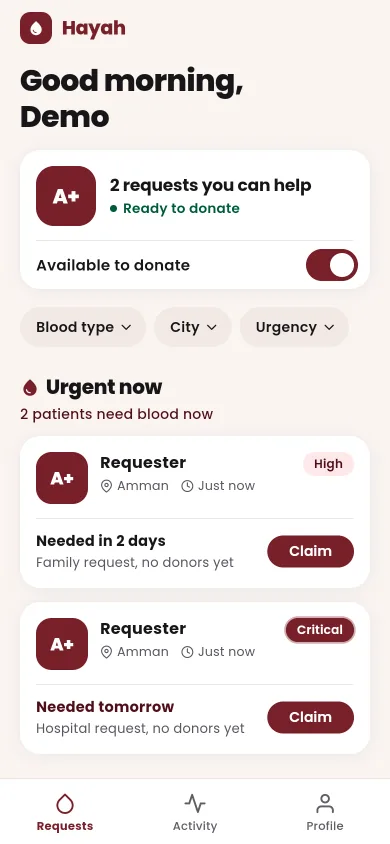
Fictional data. Explore the case study for the implementation and verification boundaries.
When it fits
An app is useful when the phone is part of the task—not simply because your business needs another channel.
A focused first product
Turn an idea into a defined first version: who it serves, the main journey and the features that can wait. Start with the smallest scope that lets people complete a useful task.
A service people return to
Support repeat interactions such as browsing information, creating a request, managing an account or checking its status. Decide which actions belong on mobile and which need staff tools.
A connected mobile experience
Plan the API and administrative workflows alongside the interface. An existing backend can be assessed before deciding what to reuse, change or build.
What we can build
A connected product needs more than attractive screens. These are the parts we can scope together.
User flows and interface design
Map the key journeys, create screen designs and define empty, loading, validation and error states. Include Arabic direction, readable text and usable touch targets.
Cross-platform application
Build a Flutter application around the agreed journeys, with reusable interface components and navigation. Choose target platforms and any device-specific requirements before implementation.
Accounts, APIs and data
Connect authentication, records and business rules to backend services. Discuss permissions, privacy, unreliable connections and the administration needed to operate the product.
Testing and handover preparation
Plan device checks, selected end-to-end flows, environment setup and source/documentation handover. Store submission and post-launch support are scoped separately where needed.
The final deliverables, schedule, ownership and support responsibilities are agreed in the project scope—not assumed from this page.
How we approach it
Define the first useful version
Identify users, priorities, existing systems and constraints. Agree which flows are in scope and how they will be checked.
Design the main journeys
Review navigation and screen states before investing in implementation. Resolve language and platform requirements early.
Build connected flows
Develop the app and required services in reviewable increments. Keep permissions and data validation on the server where appropriate.
Verify and prepare release
Check the agreed flows on target devices and document setup and handover. Confirm who owns accounts, deployment and ongoing maintenance.
Relevant work
These are projects from founder Mohammad Shams’s own portfolio, not client endorsements. Screenshots use fictional local demo data; they are not usage or outcome metrics.
Flutter · Requests & accounts
Hayah
A mobile experience for donors and requesters, connected to a Next.js API and staff console. The case study shows request browsing, a request form and the separate operational workflow.
Selected local demo flows were checked. No app-store release, donation outcomes or adoption figures are claimed.
Read the case study: HayahFlutter · Commerce in development
Selleva
A storefront with product-detail and account flows backed by a Laravel API. Its case study distinguishes API-connected screens from the home and cart prototypes.
In development. Persistent cart integration and checkout remain unfinished; screenshots are not proof of completed payments.
Read the case study: SellevaBefore we start
Can we start with an MVP?
Yes. We can discuss a focused first version around a small set of useful journeys. MVP does not mean skipping validation, privacy or error handling; it means choosing a narrower feature scope.
Will the app work in Arabic and English?
Both languages can be included in the agreed scope. Translation, right-to-left layouts, mixed-language content and testing should be planned together—not treated as a final text swap.
Can you connect an existing backend?
We can review its API, authentication, data model and documentation to assess compatibility. Required backend changes and any third-party access are agreed before they become delivery commitments.
What about cost, launch timing and app stores?
These depend on the feature scope, integrations, target platforms and review requirements. We discuss them after understanding the project. Store approval is controlled by the platform; submission support and ongoing maintenance need an explicit scope.
Start with the problem, not a feature list.
Tell us who will use the product, what they need to do, and what you already have. If you have a target date or budget range, include it so we can discuss a realistic scope.